


auDA has approved in principle a change to .com.au and .net.au eligibility that would remove the 'close and substantial connection' route. It is not in force: draft rules will go to public consultation first. This guide compares today's rules with the proposal, shows who would be affected, and explains how a foreign company registers a .com.au with an Australian trade mark.
Register a Domain Without Hosting: What You Get and What You Don't
Written by Steven White ·

Introduction
Yes – you can register a domain name without buying hosting. They are two separate services sold separately: the domain is the address, the hosting is the building at that address. Registering a domain alone gives you the name, DNS control, forwarding and the right to run email on it. What it does not give you is a website: until you connect hosting, visitors will see a parking page or nothing at all. A .com costs US$11.99 for the first year and US$14.99 to renew (verified 2026-08-23), with no hosting attached and no obligation to add any.
This guide covers what a domain-only registration actually gets you, whether the “free domain without hosting” offers you have seen are real, how to register one in six steps, and what to do with the domain while it sits there.
Table of Contents
- Understanding Domain Registration vs. Web Hosting
- Is There Really a Free Domain Without Hosting?
- Why Register a Domain Without Hosting?
- How to Register a Domain Name Without Hosting
- Benefits and Drawbacks of Domain-Only Registration
- DNS Settings and Domain Forwarding Options
- How to Secure and Manage Your Domain Name
- Future Steps After Domain Registration (Without Hosting)
- FAQs
- References
Understanding Domain Registration vs. Web Hosting
Domain registration is the process of acquiring a unique web address (such as example.com) from an accredited registrar. When you register a domain, you lease the right to use that name for a set period, usually one year at a time. Web hosting provides the server space where your website’s files actually live. If the domain is your address, the hosting is the house at that address.
The confusion is worth clearing up in one table, because the three things people buy together are in fact three separate products:
| Service | What it gives you | What it does NOT give you | If this is all you have |
|---|---|---|---|
| Domain registration | The name, for as long as you renew it. DNS control, URL forwarding, subdomains, the right to point it anywhere. | Any storage or server. No web pages, no mailboxes. | The name is yours and nobody else can take it. Visitors see a parking page. |
| Web hosting | Disk space, a web server, usually databases, SSL and a control panel. | The name. Hosting on its own is reachable only by IP address. | A site nobody can find by name. You still need a domain to point at it. |
| Email hosting | Mailboxes on your domain (you@yourdomain.com), storage, webmail, spam filtering. | A website. Email and web hosting are separate products and can live at different providers. | Professional email with no website behind it — a perfectly normal setup. |
The practical consequence: registering a domain name does not automatically give you a website. The domain will exist in the DNS but will not display anything until you point it at a server. Most registrars “park” it by default, showing a placeholder page. That separation is a feature, not a limitation – it lets you secure the name first and decide on hosting later, or never.
Is There Really a Free Domain Without Hosting?
Not in the sense most people mean. Every “free domain” offer falls into one of four buckets, and in three of them you either do not own the name or you are paying for something else to get it. A domain you actually control — one you can transfer, sell, and keep if you leave the provider — has a registry fee behind it, and somebody pays that fee.
| What is offered | What you actually get | The catch |
|---|---|---|
| “Free domain” with a hosting plan | A real domain, registered in your name | It is free for the first year only, and you are paying for hosting — which is exactly what you were trying to avoid. Year two you pay the normal renewal. |
| Free subdomain (yourname.platform.com) | An address on somebody else’s domain | You do not own it and cannot move it. If the platform closes or changes terms, the address goes with it. |
| Free ccTLDs from certain registries | A domain, on paper | These have been suspended or reclaimed without warning in the past, and many mail providers treat them as low-trust. Not something to build a business on. |
| Free first year as a promotion | A real domain, in your name | Legitimate, but it is a first-year discount, not a free domain. The number to look at is the renewal. |
Which is why the honest version of the answer is about structure, not about the word “free”: almost every extension has a promotional first year and a higher standard renewal, and the renewal is the price you actually live with. For .com, verified on 2026-08-23: US$6.99 as a new-user promotion on your first one, US$11.99 for the first year after that, and US$14.99 per year to renew. Registering it does not require hosting, and you are never charged for hosting you did not add.
Current figures for every extension we sell are on the live price pages, which are updated automatically: gTLD prices and country-code prices. If cheapness is the deciding factor, the trap to know about first is in our guide to the cheapest domain extensions and their renewal prices — several of the headline-cheap extensions renew at ten times the first-year price.
Check whether the name you want is available before worrying about any of this; most of the time the answer decides the extension for you.
Why Register a Domain Without Hosting?
There are several good reasons to register a domain name even if you are not ready to build a website:
- Secure your brand or idea early: good names go fast. Registering the domain reserves it so nobody else can claim it while your project is still an idea.
- Preparation for future use: you can develop the site at your own pace without worrying that the name disappears in the meantime.
- Protecting your brand and preventing cybersquatting: registering common misspellings or other extensions of your name, parked or forwarded to your main site, stops opportunists from doing it for you.
- Resale or investment: domain investors register names purely to sell them later. No hosting is involved at any point. (Do check trademarks before you register somebody else’s brand.)
- Email without a website: you can run yourname@yourdomain.com with no website behind it at all. This is one of the most common reasons people register a domain on its own — see how to set up email on your own domain and which address to choose.
- Cost and timing: a domain is a small annual fee; hosting is a larger recurring one. Registering now and hosting later staggers the expense.
In all of these, the domain alone gives you control of the name. Many people deliberately keep registration and hosting at different companies to stay flexible — if the host disappoints you, you move the site and keep the address.
How to Register a Domain Name Without Hosting
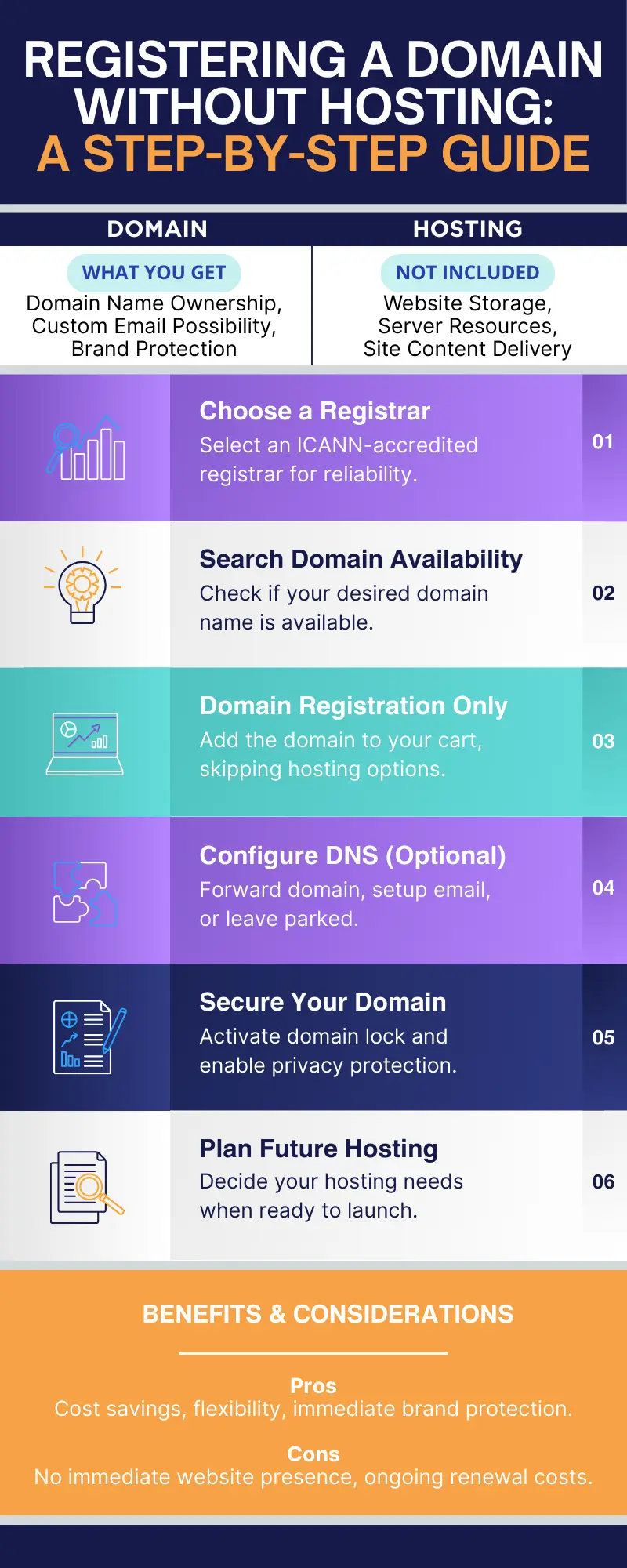
The process is identical to registering any domain, minus the hosting package:
- Choose an accredited registrar. A registrar is a company authorized by ICANN to sell and register domain names. Compare price, support, control panel and whether WHOIS privacy is included.
- Search for the name. Use the registrar’s search tool to check availability across extensions — ours checks up to 200 names at once. If the name is taken, the results will suggest alternatives; there is more on that in what to do when your domain name is taken.
- Add the domain to the cart and skip everything else. This is the step that matters for this article. Registrars commonly pre-tick hosting trials, site builders or email plans. Review the cart and remove anything that is not the domain. Choose a registration term — usually 1 to 10 years.
- Provide registrant information. Name, email, address and phone go into the WHOIS record. Enable privacy protection if the extension supports it; not all do, and which ones is covered in domain privacy by extension. Give accurate details — false information can cost you the domain.
- Review and pay. The order should show the domain and nothing else. Note the renewal price, not just the first-year price.
- Confirm and manage. You will get a confirmation email and the domain appears in your account. From there you control DNS, forwarding and renewal — without ever buying hosting.
If a provider does not allow domain-only purchases, use a different one. Standard registrars sell domains independently of any hosting, and being pushed into a bundle is a reason to leave.
Benefits and Drawbacks of Domain-Only Registration
Benefits
- Lower cost now. You pay for the domain only, which is a fraction of a hosting plan.
- Freedom to choose hosting later. With the name already secured you can compare hosts calmly, or wait for a promotion, or host somewhere different from where you registered.
- Simple portfolio management. If you hold several names for different projects or to protect a brand, keeping them all registered in one place and hosted nowhere is the tidiest arrangement.
- Immediate protection. The name is off the market the moment you register it.
- Resale flexibility. No site content to migrate if you sell.
Drawbacks
- No website. Visitors typing your domain will see a parking page or an error. If you expect people to look you up, at least set a forward or a “coming soon” page.
- A recurring cost with nothing visible to show for it. The renewal comes every year whether or not you have built anything.
- It is easy to forget. With no site to maintain, a domain can sit unused until you have forgotten why you bought it. Review your list once a year.
- You handle DNS yourself. Any real use — email, forwarding, a third-party service — means editing DNS records in the registrar’s panel rather than having a host do it for you.
- Security gets neglected. People skip the registrar lock and privacy settings on domains they “aren’t using yet”. Those matter from day one.
DNS Settings and Domain Forwarding Options

Even with no website, four things are worth doing in the DNS panel. Forwarding redirects anyone visiting your domain to another address — a social profile, a landing page, a GitHub Pages site — and most registrars include it free. MX and TXT records let you run email on the domain through Google Workspace, Microsoft 365 or a routing service, with no web hosting anywhere in the picture. A, AAAA and CNAME records let you point the name at any server you already have. And leaving it parked is a legitimate choice: the registrar shows a placeholder and nothing breaks.
When you eventually buy hosting, you either replace the nameservers with the host’s, handing them all DNS control, or keep your registrar’s DNS and edit the A record yourself. The second option is more work and more control, and it is what you want if web and email live at different providers. Either way, changes take from a few minutes to 48 hours to propagate.
How to Secure and Manage Your Domain Name
Domain security hygiene is the same whether or not there is a site attached, and it comes down to five habits: keep the registrar lock on so nobody can transfer the name away; protect the registrar account with a strong password and two-factor authentication, because that account is the domain; keep WHOIS privacy enabled where the extension offers it; keep the contact email current and hosted somewhere other than this domain, so renewal warnings still reach you if something goes wrong; and turn on auto-renew.
That last one is where most domains are actually lost. An expired domain does not disappear immediately — it moves through a renewal grace period, then redemption (where recovery costs several times a normal renewal), then release, and at that point anyone can register it. The full timeline, stage by stage with what each one costs, is in our domain expiration and renewal guide.
One scam worth naming: fake renewal notices, by email or paper mail, asking you to pay an inflated fee or transfer to another company. Never renew from a link in a message. Log into your registrar account directly and check the expiry date there.
Future Steps After Domain Registration (Without Hosting)
When you are ready to put the domain to use:
- Decide what it is for. A static brochure site, a shop and a database-driven application need very different hosting. Working this out first prevents buying the wrong plan.
- Choose hosting. Shared hosting suits most small sites; VPS or cloud gives more control as you grow; static hosting is free and enough for a single page. Check the renewal price of the hosting too — low introductory rates are as common there as they are on domains.
- Connect the domain. Either point your domain’s nameservers at the host, or keep your DNS and add an A record for the domain and the
wwwsubdomain. You do not need to buy a new domain from the host; every host has an “I already have a domain” option. - Build, secure and launch. Upload or build the site, enable the free SSL certificate almost every host now includes, and test that
https://yourdomain.comloads. - Keep the good habits. Renewals, lock, backups. The domain is the asset; the site is replaceable.
Registering a domain without hosting buys you time and flexibility, and there is no deadline attached to it. When you are ready, start by checking that the name is still free — and if it is, take it now and decide about hosting later.
FAQs
Can I just buy a domain name without hosting?
Yes. Domain registration and hosting are separate products. You can buy the domain on its own from any accredited registrar and never add hosting.
If I have a domain, do I need hosting?
Only if you want a website at that address. You do not need hosting to own the name, to forward it somewhere else, or to run email on it.
How much does a domain cost without hosting?
It depends on the extension. A .com is US$11.99 for the first year and US$14.99 to renew (verified 2026-08-23); country-code and specialty extensions range widely on either side of that. The current list is on the gTLD and ccTLD price pages.
Is there a genuinely free domain without hosting?
No, not one you own. Free offers are either subdomains on someone else’s name, first-year promotions, or bundled with a hosting plan you have to keep paying for. See the table above.
What happens if I register a domain and do nothing with it?
It stays yours as long as you renew. Visitors see the registrar’s parking page. Nothing else happens, and nothing breaks.
Can I use email with a domain but no hosting?
Yes — email hosting is a separate service from web hosting. Add MX records pointing at your mail provider and the domain delivers mail with no website behind it.
References
- Nonprofits Decoded – Domain Registration vs. Web Hosting
- Design Powers – Understanding the Differences Between Domain Names, Registration, and Hosting
- redirect.pizza – What is Domain Parking?
- ZeroFox – 7 Proven Strategies for Domain Name Security