

An event study of the .com wholesale price increases of 2021-2024 with ICANN's monthly registry reports: renewals rose 36.4% and 38.3% before the 2021 and 2022 increases, and TurnCommerce (NameBright) accounted for 90.5% and 93.8% of the extra renewals. Without it the market moved 0.5%-3.5%, within normal monthly variation. Includes the registrar's month-by-month renewals, Verisign's own filings on early renewals, the first data on the November 2026 increase and when the October report will show the answer.
What Is the .no Domain?
Written by Steven White ·
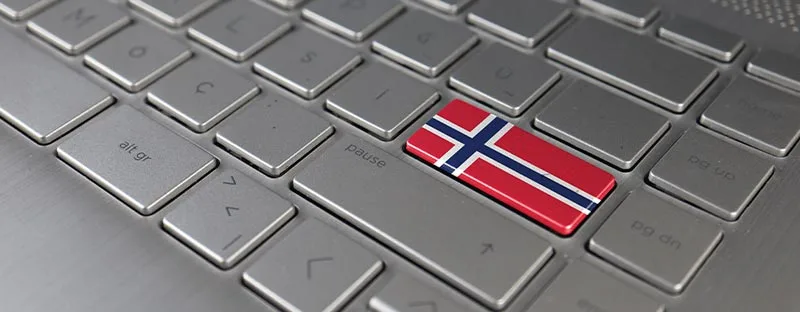
There are literally hundreds of domain names to choose from when setting up a website. Some are very well-known, like .com, .net, and .org. Others are a little less commonplace, like .no, which you may not have encountered before unless you happen to be based in Norway.
That’s because .no is the official country-code top-level domain (ccTLD) for the nation of Norway. Let’s learn more about it.
An Introduction to the .no Domain
Almost every country in the world has its own ccTLD – a domain name reserved specifically for that particular country and which derives its name from it. Like .fr for France, .uk for the United Kingdom, and .cn for China. .no is Norway’s equivalent.
The history of this domain name goes back to the late ’80s and it had amassed a thousand registrations by the mid-’90s. But the rules around .no domain registration have changed a lot over the years – private Norwegian citizens were only granted the option to make their own .no domains in 2014, for example.
The domain name is managed by an organization called Norid, which sets strict rules regarding how the domain is used and who is allowed to have a .no address. Norid has overseen the creation of over 850,000 .no sites, with hundreds more registered daily.
Rules Around .no Registration
.no domain names aren’t available for everyone. There are some ccTLDs that offer worldwide registration without any notable restrictions. So anyone can make a website using those particular ccTLDs. But that’s not the case with the .no domain.
- Only Norwegian citizens and businesses are allowed to register a .no domain.
- Applicants must provide proof of a physical address in Norway.
- They also have to provide documentation like a VAT ID for businesses or PID for individual applicants.
- There are restrictions on how many .no sites you can have, too. Businesses and organizations are allowed up to 100 domains, while private citizens can have a maximum of five.
So, if you’re not based in Norway or have no connection to the country, you’re out of luck in terms of getting a .no domain extension.
Why? Well, every country has its reasons for deciding whether or not to restrict ccTLD registrations to local people or to open them up to the world. By keeping .no sites for Norwegian people and businesses only, Norid helps to keep the .no domain as a sign of trust and credibility. When you visit a .no site, you know for sure that it’s owned and operated by a business or individual with real ties to Norway.
How the .no Domain Is Used
Here are some of the ways in which the .no domain is put into action:
Norwegian Brands and Businesses
Since its inception, .no has proven popular with various brands and businesses based in Norway. Banks, retail chains, restaurants, and more all tend to have .no addresses, as .no websites perform well on Norway’s version of Google and are widely trusted among the country’s population.
Non-Profits and Government Entities
Non-profit organizations based in Norway can also set up their own .no addresses, as can Norwegian government entities and official agencies. In fact, some of the earliest ever .no domains were used for this purpose and there are special second-level .no domains reserved for schools, the Government of Norway, museums, and municipalities.
Norwegian Citizens
As mentioned above, .no domain registration was opened up to the country’s private citizens in 2014. Since then, lots of local people have started their own .no websites, such as artists, celebrities, independent workers, and so on.
Register Your .no Domain
So, if you manage to meet the necessary criteria for a .no domain, it could be a good choice because it can help you appeal to the Norwegian market and gain trust among the Norwegian people. You can run a domain name availability check to see if your desired name is available and then proceed with registration.
Or, if you don’t quite meet the requirements, a more open and accessible European ccTLD might be a better choice, like .se – the ccTLD for Norway’s Scandinavian neighbor, Sweden, which is open for registration to all.