


Zone files and registry RDAP data show about 2,700 .eat, .fly and .here domains registered in the first 25 hours of general availability on 17-18 November 2026, more than ten times the sunrise total. Counts by extension and launch phase, the first-two-hours rush, and the shift from brand-protection registrars in sunrise to retail registrars on opening day.
Understanding the .es Domain
Written by Steven White ·
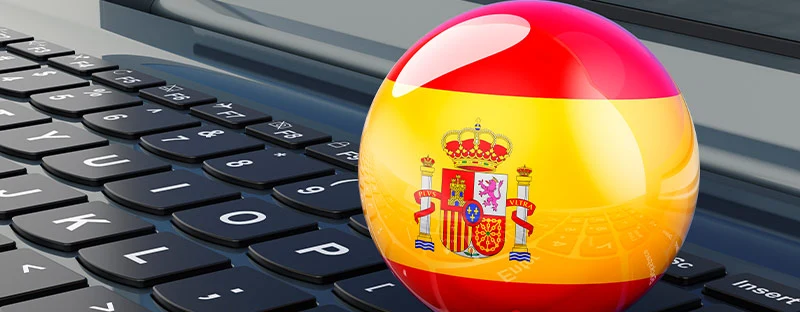
Every web address needs a domain name. For the uninitiated, domain names are the small pieces of text at the end of a web address, like .com or .org. There are lots of different options for your domain name, including .es, the official domain name for the country of Spain, or España in Spanish.
Is .es right for you? Why might you want to obtain a .es domain, even if you’re not based in Spain? Read on to learn all you need to know.
What Is the .es Domain?
First, the basics – as touched on above, .es is the main domain name for the European nation of Spain. It’s what’s known as a ccTLD, or country-code top-level domain. As the name suggests, ccTLDs are TLDs designed specifically for use in different countries, like .uk for the United Kingdom or .fr for France.
According to recent statistics, .es ranks among the top 40 most popular TLDs in the world. It’s nowhere near as popular or widespread as the likes of .com or .net but is naturally one of the most commonly selected TLDs among the Spanish population.
Are There Any Special Requirements to Obtaining a .es Domain?
No. .es domains are available to anyone who would like to register one, even though they’re generally best used by those with close ties to Spain. In the past, there were quite strict rules for registering a .es domain, like needing to provide proof of a valid trademark in Spain, but those rules have been dropped.
How to Get Your .es Domain
Getting your own .es domain is quite a quick and easy process, once you know how. First, you’ll need to ensure that your domain name is available. You can use various availability checkers online to do this. From there, it’s a case of finding a trusted domain name registration provider to form your site.
Reasons to Choose a .es Domain
You might assume that the only people who need a .es domain name are Spanish people who live and work in Spain. However, that’s not necessarily the case. While Spanish people are the obvious primary audience for .es domains, other people around the world may also have reasons to use this ccTLD.
Spanish People, Businesses, and Organizations
We’ll begin with the most obvious reason to choose a .es domain: you live or work in Spain. Like all ccTLDs, .es is mainly aimed at the market it was made for. It’s one of the go-to domain names for Spanish people.
Spain also regularly uses .com and other domains, but a lot of big Spanish sites have the .es extension. So, if you’re living in Spain, setting up a business, or want to appeal to the Spanish population without having to invest in an expensive .com address, .es may be the way to go.
Expanding Into the Spanish Market
The domain .es isn’t just for businesses and organizations that are based solely in Spain. Let’s say, for example, that you run a company that has grown to the point where you want to expand into new regions. Or you’re setting up an online business that offers products or services around the world.
In either of those cases, it could benefit you to register a .es domain, purely to improve your reach with the Spanish market. You might also like to register other domains for other countries, like .fr and .de in order to target additional audiences in Europe and beyond.
SEO for Spanish Speakers
Having a .es web address is also great for your SEO if you’re hoping to reach a Spanish-speaking audience. People in Spain tend to use Google.es, the Spanish version of Google to look for things. This version tends to rank .es sites higher than others, as they should be more relevant to users.
Wordplay and Innovation
Finally, it’s worth noting that there are some fun “domain hacks” and bits of wordplay you might accomplish with a .es address. If your business name includes a word that ends with “-es” for example, “Planes,” “Taxes,” or “Fries,” you could incorporate a .es extension to make a clever web address.
Get Your .es Domain Today
The domain .es could be the ideal domain extension for you. If so, don’t delay. Domain names are being claimed every second, and you could miss out on the name you’re looking for if you wait too long. Register your .es domain today.