


Most domains register in minutes, but a quarter of all extensions do not. This guide shows registration times across 1,187 extensions, the slow ones and what their registries check (.cn, .sa, .co.jp, .bg, .ie and more), the checks that come after registration, and how long a domain transfer takes.
.es Domain Registration: All You Need to Know
Written by Liam Campbell ·
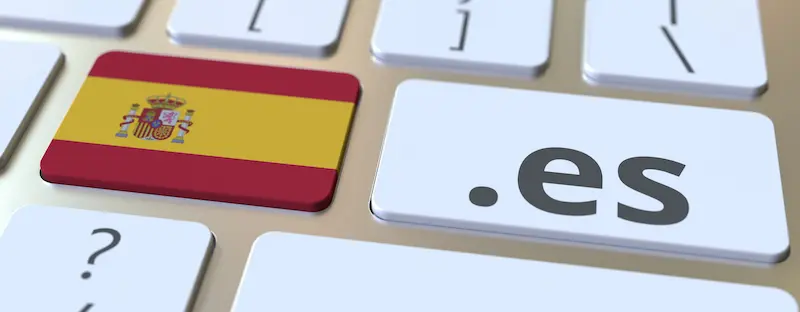
Every website needs a domain name, and there are numerous options to choose from. You'll undoubtedly be familiar with many of them, such as .com, .org, and .net, to name but a few. Others tend to be less well-known among large parts of the population, like .es.
This guide explores what .es is, the nature of the .es domain, its applications, and why it's worth considering the next time you set up a new website.
Table of Contents
1. An Introduction to the .es Domain
Almost every country around the globe has its own specific domain name, called a country-code top-level domain, or ccTLD. There's .us for the United States, for example, and .fr for France. The domain .es is the ccTLD for the European nation of Spain, with the "es" letters being an abbreviation for "España."
Like a lot of other ccTLDs, .es was launched in the 1980s – April 1988, to be precise. It's operated by the Network Information Center of Spain, which imposed strict rules around .es domain registration for a number of years, but has but has since simplified the process for users to set up .es websites.
Now, there are more than two million .es websites, making .es one of the most popular and widely-used ccTLDs in the world today.
2. Rules for .es Domain Registration
Many ccTLDs have rules in place to control who can register them and how they can be used and .es is no different. As stated above, it was once quite difficult to set up an .es website. Users needed to have valid trademarks in Spain, for example, to set up .es domains.
Fortunately, it's now much easier, especially for those outside of Spain. However, you still need to have some sort of proven connection to the country by providing a government-issued ID number during .es domain registration.
You can receive one of these ID numbers on Spanish passports, driver's licenses, tax ID cards, and company registration documents. If you don't have any of those, there's no need to fear – you can still set up your .es website with the help of a registration partner.
To do that, follow these steps:
1Decide on a name you want to use for your website.
2Check that the name is available with the .es extension.
3Find an .es registration partner to assist you in meeting the necessary legal requirements.
4Enter your site's details, pay any relevant registration fees, and then start using your new .es website.
3. Uses of the .es Domain
So, why would you want to set up your own .es website? Well, while it may, at first glance, seem that .es is only useful for businesses and individuals based in Spain, it offers a variety of potential uses, including:
3.1 Spanish Brands, Businesses, and People
Just like almost every other ccTLD, the main use for .es is for Spanish people and businesses. Spanish banks, schools, brands, government agencies, etc., all tend to have their own .es websites, and Spanish consumers and businesses tend to see the .es extension as a sign of credibility. Anyone based in Spain should therefore consider .es as a strong starting point for building a digital brand.
3.2 Brands Expanding into the Spanish Market
You might already have an established online business or digital presence in other markets, but have plans to expand into Spain. If so, relying on your existing .com or similar site might not be enough. Setting up a .es site could be an effective way to quickly gain trust and traction with the local population and give your brand a head start.
3.3 Domain Hacks
Domain hacks are web addresses that use the domain name to form part of a larger word, phrase, or brand name. .es works particularly well for this, especially for English speakers, since so many words end with those two letters. You could incorporate the .es extension into words like "Cities," "Places," "Spaces," and so on, creating unique and catchy web addresses in the process.
4. Register Your .es Domain
Whether you want to get ahead in the Spanish market or are simply looking for an alternative domain name that is quirky, appealing, and fun, .es is well worth considering. Start your journey to .es domain registration today and experience the benefits of this domain name firsthand.